The Full Voyage
It is time to close the logbook.
By now, we have covered a lot more than a few container commands and a hosting walkthrough. We have traced a real arc from local development to live deployment, and then one step further into the discipline of supporting software after launch.
That is a meaningful finish line.
This is not just the end of the lesson. It is the end of our time together.
That makes this a good moment to step back and look at the whole voyage.
From Code on a Laptop to a Live System
Section titled “From Code on a Laptop to a Live System”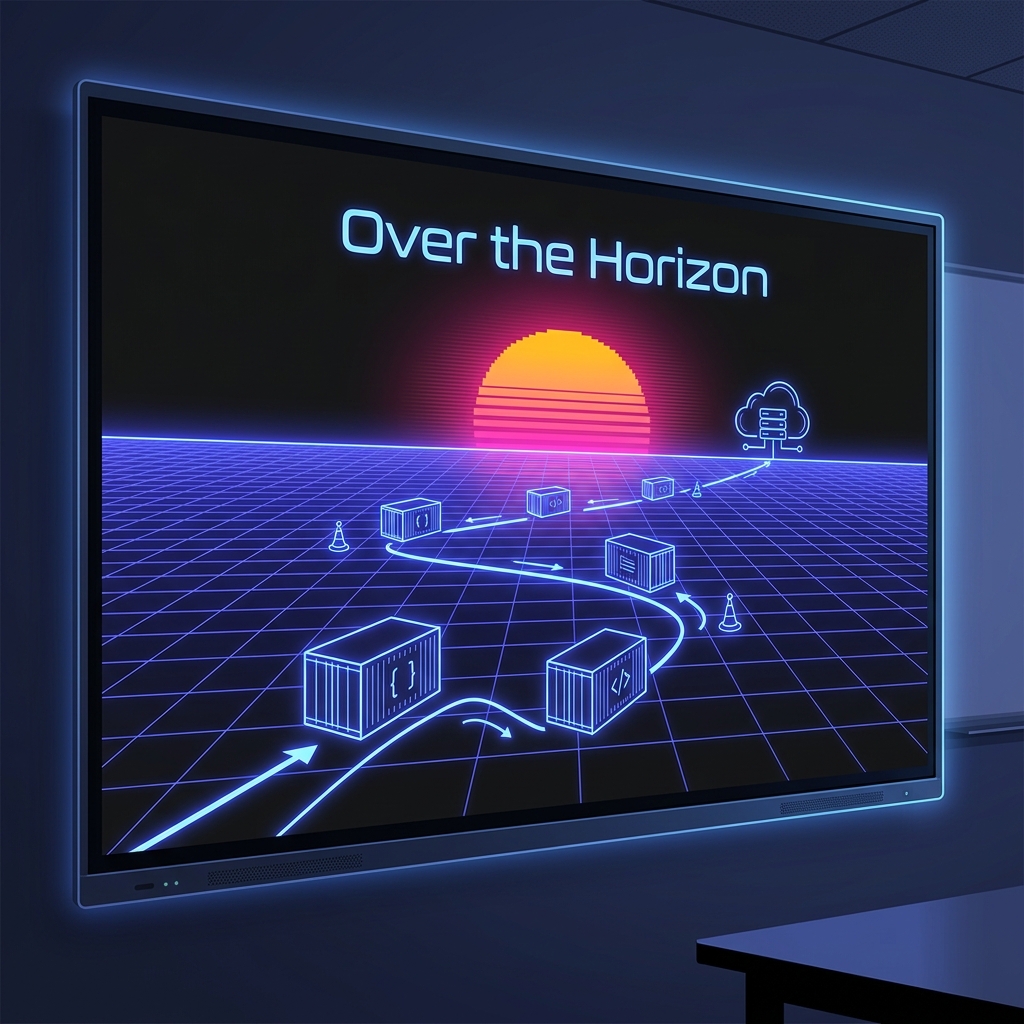
Fig 1. The entire delivery arc: leaving the local harbor to become a live system over the horizon.
When this journey began, the application lived entirely in a familiar, highly controlled place:
your machine.
That world is comfortable.
You write code. You run it locally. You watch the terminal. You refresh the browser. You fix a bug. You try again.
That is an essential stage of learning, but it is not the whole story of software delivery.
A local application is potential. A delivered application is a system.
What we spent this course doing was building the bridge between those two states.
1. Packaging the Application
Section titled “1. Packaging the Application”The first shift was learning to package the application in a way that was more reliable than “it works on my machine.”
We used Dockerfiles to define repeatable environments and to freeze the assumptions the application depended on.
That changed the conversation.
Instead of relying on:
- local machine quirks
- manually installed dependencies
- invisible environment differences
we moved toward a more stable model:
- defined runtime environment
- reproducible setup
- clearer separation between code and machine
That is a foundational professional habit.
Packaging taught us that software is not just source code. It is source code plus environment plus assumptions. Once we started defining that environment explicitly, the application became far more portable and predictable.
2. Orchestrating the Stack
Section titled “2. Orchestrating the Stack”Next, we moved from a single container mindset to a multi-service mindset.
That meant learning how to coordinate:
- the application
- the database
- ports
- service names
- persistent storage
- local networking
Docker Compose helped us understand that modern apps are rarely just one thing.
They are small systems made of parts that need to cooperate.
That cooperation includes:
- how services find each other
- how they share configuration
- how data survives restarts
- how local development can model a more realistic architecture
This was the point where the app stopped feeling like “some Node code” and started feeling like an actual stack.
3. Deploying Beyond Local
Section titled “3. Deploying Beyond Local”Then we left the local harbor.
We took what had been a local, Compose-driven application and started stripping away the assumptions that only worked on one machine.
That meant:
- moving configuration into environment variables
- separating local defaults from hosted runtime behavior
- switching persistence to MongoDB Atlas
- packaging the app with a multi-stage Docker build
- handing the runtime over to Render
That phase mattered because it forced the code to become more honest.
It could no longer assume:
- a fixed port
- a local database hostname
- a development server serving the frontend
- a human sitting beside it ready to restart it instantly
The app had to become deployable. Then it had to become survivable.
Getting the app online was a huge milestone, but it was not the end of the work. Deployment simply changed the nature of the work from “how do we run this?” to “how do we understand and support this now that it is live?”
4. Learning to Support What We Ship
Section titled “4. Learning to Support What We Ship”That final shift is what this lesson has really been about.
Once an application is live, it needs more than a public URL.
It needs signals.
That is why we added production-aware touches like:
- startup logs
- request logs
- error logs
- a heartbeat endpoint
- a version endpoint
- deployment history as operational context
Those additions were small in code size, but huge in meaning.
They taught an important lesson:
software should not just run — it should be understandable.
A deployed app that emits no useful signals leaves its operators guessing. A deployed app that explains itself, even a little, becomes far easier to support responsibly.
That is the beginning of operational maturity.
What We Actually Learned
Section titled “What We Actually Learned”One of the easiest traps in a journey like this is to think:
“Okay, I learned Docker.” or “Okay, I learned how to deploy to Render.”
That is true, but it is much too small.
What we really learned was a delivery model.
We learned how software moves through stages like:
- local development
- containerized packaging
- service orchestration
- managed persistence
- hosted runtime
- operational visibility
That is a much bigger skill than memorizing commands.
It is a mental model.
And once that mental model is in place, the rest of the ecosystem becomes far less intimidating.
Docker may evolve. Render may be replaced. Atlas may not be the database you use next year. But the underlying ideas — packaging, orchestration, configuration, deployment, visibility, and support — are much more durable than any specific platform.
The DevOps Perspective
Section titled “The DevOps Perspective”By the end of this module, you should be seeing software differently.
Not just as files. Not just as code. Not just as something that “runs.”
But as something that has:
- dependencies
- environments
- infrastructure
- release history
- operational signals
- responsibilities after launch
That perspective is one of the biggest differences between beginner development and professional software delivery.
It does not mean you now know everything in the DevOps ecosystem.
Nobody does.
It means you now understand the center of the map.
And that is what makes the rest learnable.
What Comes with You Next
Section titled “What Comes with You Next”The most valuable things we take from this journey are not tied to a single tool.
They are habits of thought.
Things like:
- isolate assumptions
- define environments explicitly
- avoid hardcoded secrets
- treat deployment as an engineered process, not a magic act
- make applications easier to understand in production
- connect failures to evidence instead of superstition
- support software after launch, not just before it
Those habits matter whether you are working on:
- a small Node app
- a large team product
- a cloud platform
- a mobile backend
- or something none of us have touched yet
That is why this material matters beyond the course itself.
ShipShape Complete
Section titled “ShipShape Complete”This is the end of the ShipShape curriculum.
We set out to move from raw code to packaged, orchestrated, deployed, and observable software.
We did that.
We did not cover every corner of the DevOps universe, and we were never meant to.
What we did build was a strong, practical through-line:
- how an application leaves a laptop
- how it becomes a running system
- how it survives in hosted reality
- and how the people responsible for it begin to make sense of what it is doing once it gets there
That is a strong finish.
Finishing this unit does not mean the map is complete. It means we now know where we are on it. The next tools, platforms, and architectures we encounter will make far more sense because we have already learned the core delivery arc underneath them.
Final Reflection
Section titled “Final Reflection”We now know how to take an application from:
- local code to
- containerized system to
- deployed service to
- observable runtime
That is not trivial.
That is real engineering growth.
The cargo is delivered. The system is visible. The map is drawn.
Where we sail next is up to us.
Extra Bits & Bytes
Section titled “Extra Bits & Bytes”Google SRE Book: Principles
⏭ Dry Dock Drills
Section titled “⏭ Dry Dock Drills”The core voyage is complete. Now take one more pass through the optional drills and reference pages to reinforce the concepts and keep the operational habits sharp.