Why DevOps Became Necessary
The older split: Dev vs Ops
Section titled “The older split: Dev vs Ops”Historically, many organizations separated software work into two broad groups: Development and Operations.
| Development | Operations |
|---|---|
| Building features | Servers |
| Fixing bugs | Uptime |
| Writing code | Deployment |
| Moving quickly | Networking |
| Shipping changes | Backups |
| Security | |
| System stability |
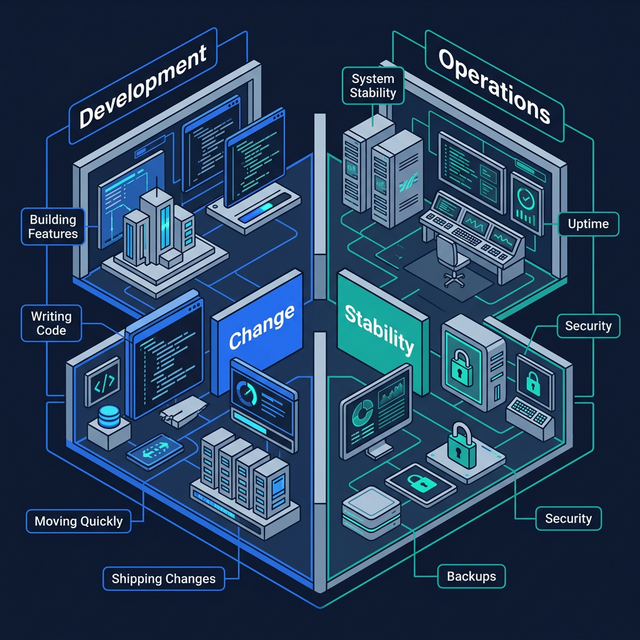
Fig 1: The Dev vs. Ops Split (Change vs. Stability)
Both groups were doing legitimate work. The problem was that they often had conflicting incentives.
Developers were rewarded for change. Operations teams were rewarded for stability.
That created tension fast. Every new change a developer introduced was a potential threat to the stability the operations team was evaluated on.
The “throw it over the wall” problem
Section titled “The “throw it over the wall” problem”A classic anti-pattern looked like this:
- Developers build the application.
- Developers say, “It works on my machine.”
- The code gets handed off to operations.
- Operations now has to somehow make it run in an unfamiliar environment.
That handoff often included missing information, vague instructions, or tribal knowledge like:
- “Oh, you need Node 18, not Node 20.”
- “It only works if that config file is present.”
- “You need to run this command first.”
- “The app writes files into a folder we forgot to create.”
- “The environment variable names are slightly different in production.”
That is not a strong delivery model. That is a chaos relay race.
What DevOps changed
Section titled “What DevOps changed”DevOps developed as a response to that friction.
The goal was not to erase all roles or make everyone identical. The goal was to create:
- tighter collaboration
- shared ownership
- automation where possible
- faster feedback
- more reliable delivery
- more predictable operations
In other words: stop treating deployment and operations as an awkward after-party after the “real” development work is done.
Extra Bits & Bytes
Section titled “Extra Bits & Bytes”Atlassian: A Brief History of DevOps
⏭ Beyond a Job Title
Section titled “⏭ Beyond a Job Title”So, we’re not just throwing code over walls anymore. But if DevOps isn’t just a role, what does the actual workflow look like?